
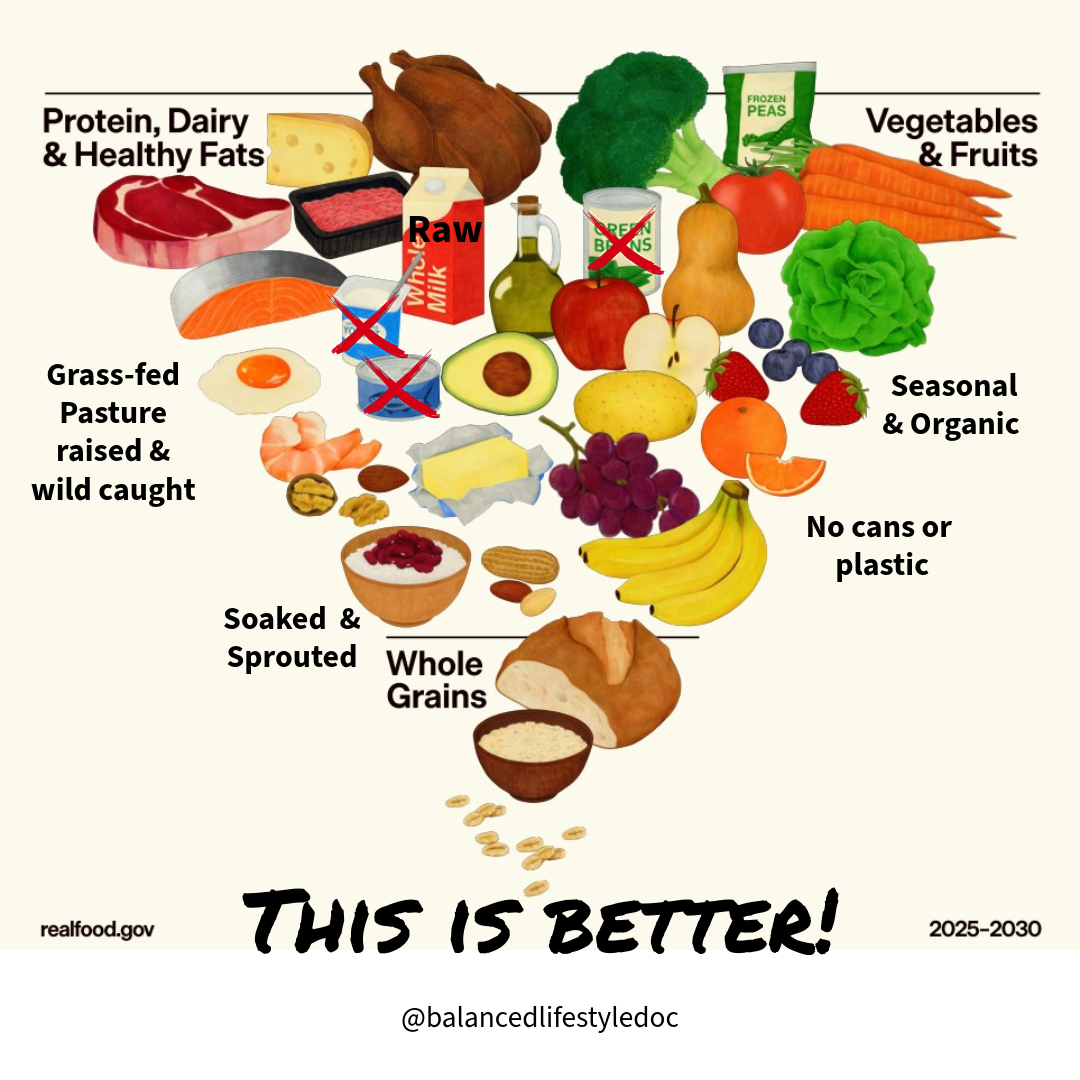
The new USDA dietary guidelines are a great step in the right direction.
The message: EAT REAL FOOD.
What could be simpler?
Sadly, in modern culture simple is not as straightforward as we would like.
While I do love the symbolism of flipping the 1992 food pyramid upside down, along with the Eat Real Food message. I do feel the pyramid and guidelines could use a bit of added context.
Grass-fed, pasture raised, & wild caught meat:
Conventional and factory farm corporations grow so large they treat animals purely like a commodity. They feed animals and fish genetically modified (GMO) corn, soy and grains sprayed with pesticides and herbicides for cheap and efficient growth and fattening. Animals and fish raised on this supplemental diet have higher levels of omega 6 fatty acids. While omega 6 fatty acids are essential, the levels eaten in the Standard American diet are largely out of balance with essential omega 3 fatty acid consumption, at times 40:1. This imbalance creates a condition of chronic low-grade inflammation which increases oxidative stress and mortality risk. When you hear red meat is bad for your heart, that is accurate when the meat comes from cattle raised on corn and soy. On the other hand, pasture raised animals and wild caught fish that eat their native diet are higher in omega 3 fatty acids. Omega 3 essential fatty acids are important for brain, cardiovascular, metabolic and hormonal health. Keeping the dietary ratio of omega 3 and 6 in a 1:1 balance is important overall health and vitality.
When purchasing meat look for grass-fed beef, pasture raised poultry and eggs and wild caught seafood.
Raw Dairy from A-2 casein cows:
Dairy in its natural raw form is far superior to a pasteurized and homogenized product. Raw dairy from well kept farms with healthy animals is nutrient dense and still contains the natural enzymes needed for digestion. There is also a difference between A-1 casein cows and A-2 casein cows. Holstein cows, the black and white cows, often carry a genetic mutation where they produce milk with the A-1 casein protein. Because Holstein cows are hearty milk producers, A-1 casein milk is common in commercially available dairy products. However, A-1 casein is harder to breakdown and digest. Cows from the Guernsey, Brown Swiss, and Belgian Blue breeds produce A-2 casein. Milk from A-2 casein breeds can be difficult to find in grocery stores. However, raw milk from A-2 cows can be farm sourced. For those with issues digesting dairy, raw A-2 can be a viable option along with milk from goats and sheep.
When purchasing dairy look for raw products from A-2 Guernsey, Brown Swiss or Belgian Blue breeds.
Seasonal and Organic Produce:
Eating fresh produce out of season is a relatively new practice. For millennia fresh fruits and vegetables were only available at peak times of each season. This meant food consumption varied throughout the year depending on availability. This left seasons where food was scarce and dependent on hunting abilities. Now we have grocery stores filled with meat and produce at the ready. This allows us continuous access to sweet fruits and sugary treats year round. This also means seasons of reduction and fasting have been exchanged with growing waistlines and an increase in chronic diseases.
The term quality produce comes with several meanings. In a grocery store, quality produce would be defined as attractive in appearance and easily sellable. However, real quality goes deeper than appearances. Conventional produce can be a mix of genetically modified organisms (GMO’s) along with pesticide and herbicide laden fruits and vegetables. GMO produce is a concern for several reasons including horizontal gene transfer. This is where genetic material is transferred between host and recipient. While transfer to humans is still poorly understood. Studies have shown that gut bacteria necessary for the breakdown of food, have the potential for gene transfer. This means the bacteria necessary for digestion could be altered.
The rampant use of pesticides leaves our food system in a strange paradox of poisoning the food so pests won’t eat it, then selling it to humans for consumption. Herbicides and pesticides have been linked to an array of health issues including disruption of the gut microbiome, damaging the interstitial epithelial junctions in the small intestine, as well as interference with key enzymes including cytochrome P450 which is essential for detoxifying the body of toxicants including pesticides and herbicides.
When purchasing produce look for local organic and in season fruits and vegetables.
No plastic or metal storage containers:
Metal cans like tuna cans and soda cans contain an epoxy liner often made from Bisphenol A (BPA), or newer versions like Bisphenol F and S. BPA has been shown in studies to be an endocrine disruptor, which means it can interfere with natural hormone signaling. BPA has the ability to act like a fake estrogen or a xenoestrogen. This xenoestrogen can bind to estrogen receptors creating issues linked to early puberty and reproductive issues like egg quality in women and lower sperm count in men. Studies have also shown that BPA can interfere with thyroid hormones, cause insulin resistance and affect how the body stores excess fat. While early manufacturer testing shows BPF & BPS to be biologically inert, there are still valid concerns about how the chemicals interact with stored food.
Plastic food containers may also contain bisphenols along with other endocrine disrupting chemicals known to leach into food through contact. Plastics often contain a mix of chemicals including phthalates and PFAS to make the product flexible and durable. Per- and polyfluoroalkyl (PFAS) is a group of synthetics known as forever chemicals because the carbon-florine bond does not break down in the body or the environment. These chemicals can cause a host of issues including immune suppression, liver and kidney damage, endocrine and metabolic disruption.
Micro and nanoplastics are an additional concern. New studies have shown that plastic containers shed millions of microscopic particles, especially when scratched or punctured. Accumulation of these plastics can lead to cellular damage, cardiovascular risk and alter the gut microbiome.
When shopping look for food that comes in its original form or is packaged in glass or paper.
Soaked & sprouted grains, seeds, nuts & legumes
For millenia, soaking, sprouting and fermenting has been part of traditional food preparation. Traditional cultures understood what modern scientists are now confirming. Plants evolved to be master chemists. If you can’t bite, claw or flee your attacker, poisoning the seeds and fruits until they are ready to regenerate is all that is left to survive. Traditionally, foods containing anti-nutrients like phytic acid and lectins were carefully soaked, sprouted or fermented.
Phytic acid found in the hull of seeds and grains has been labeled as a “mineral robber” as it acts like a chelator, binding minerals like calcium, magnesium, copper, iron and zinc in the intestinal tract. Whole grains, which have recently grown in popularity due to their increase in nutrients, come with a caveat. Those nutrients are locked in the hull by phytic acid. This leaves folks struggling to digest whole gains while becoming nutrient depleted.
Lectins are large proteins plants use to defend themselves. Gluten has become the most notorious lectin due an increase in allergy and sensitivity awareness. Lectins can cause a host of issues when they bind to complex sugars called polysaccharides and sialic acid. Once lectins bind, they can interrupt cell messaging, causing inflammation, brain fog and weight gain.
Plant seeds also contain enzyme inhibitors that keep the seed dormant until there is enough water and warmth for the seed to germinate. These inhibitors can block the body’s digestive enzymes like pepsin and amylase which are necessary to break down the protein and carbohydrates in seeds which include nuts, legumes and grains.
When consuming grains, nuts, seeds and legumes soak, sprout or ferments before consumption. Refer to this article for instructions.
Everything that touches our senses whether we taste, smell, hear or see it, creates a cascade of electrical and chemical reactions. I recently had a client tell me after several months of consultations “there is nothing simple about nutrition”. That is absolutely correct. The area of nutrition has been incredibly simplified, seemingly to meet food manufacturers’ sales quotas. This simplification was also adopted by medical professionals with “calories in, calories out”. All while convincing patients that Cheerios for breakfast was better choice than an egg. But, times are changing. We understand that simple calorie counting is far from optimal nutrition and processed food cannot replace the nutritional value of real whole foods.
Resources:
USDA, Dietary Guidelines, 2025, https://cdn.realfood.gov/DGA.pdf
Weston A. Price Foundation, Wise Traditions, https://www.westonaprice.org/Hjn69c#gsc.tab=0
The Plant Paradox, Gundry, Harper Wave, 2017.
PMC, Horizontal Gene Transfer, 2015. https://pmc.ncbi.nlm.nih.gov/articles/PMC4536854/
Glyphosate: Modern Attack on the Gut, Bush. https://zachbushmd.com/wp-content/uploads/2017/04/Glyphosate-for-ProHealth-FINAL-v3.pdf
Toxic Legacy, Seneff, Chelsea Green, 2021.
NIH, Endocrine Disruptors, https://www.niehs.nih.gov/health/topics/agents/endocrine
Research Gate, Rotimi, 2024, The Impact of Bispenol-A on Human Reproductive Health. https://www.researchgate.net/publication/385066842_The_Impact_of_Bisphenol-A_on_Human_Reproductive_Health
MDPI, Grattagliano, 2025, An Overview on Microplastics Hazards to the Marine Ecosystem and Humans’ Health. https://www.mdpi.com/2073-4441/17/7/916
NIH, Varre, 2025, Nutritional Composition of Beef: A Comparison of Commercial North American Grass- and Grain-Finishing Systems. https://pubmed.ncbi.nlm.nih.gov/41414663/

I couldn’t resist commenting. Perfectly written!
Pleased to be here and happy to join. I discovered this site not long ago and decided to register after seeing how much helpful content is already shared. It’s nice to see a place where people are willing about sharing their experiences and offering helpful advice. I’m still new, but I’m enjoying reading through everything so far. I have been reading about this recently.
You can definitely see your enthusiasm in the work you write.
The world hopes for more passionate writers
like you who are not afraid to say how they believe.
At all times follow your heart.